Showing posts with label Ask Best Events. Show all posts

Wednesday, December 9, 2015

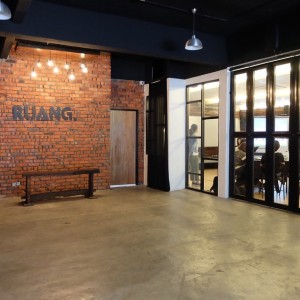
Ruang
The nearly limitless potential of an unused warehouse or an open loft can spark an event host’s creativity, but the flip side to that freedom is that raw space can demand much more in terms of logistics, from permitting to scheduling to laying out the space. Above and beyond the usual rundown event and meeting professionals would ask a venue before signing a contract, insiders say there are a number of specific, sometimes surprising questions that need to be asked when it comes to taking over raw space for an event.

1. Are you legally allowed to have events?

It sounds like a no-brainer, but it is a question planners need to ask when considering raw space. “Many raw spaces are not licensed to host events, so the first thing is to ask to see an occupancy certificate and what licenses they have,” says Sean Cannon, owner and C.E.O. of Event Creative in Chicago. “There are too many raw spaces that just decide to rent out for events,” he says, without bothering to verify the legality first.

2. What permits will we need?

Permitting is a topic that should be brought up regardless of where an event is being held, but raw space might have special requirements or considerations. If organizers are running a generator for auxiliary power or need to valet cars from the street, for example, they might need specific permits for those activities. Likewise, “Ask if their loading space requires street closure permits for load in and load out,” says Jeremy Nichols, executive producer at Sonoma, California-based Pix Productions.

3. Will we need to bring a generator?

If the event requires running catering, lights, audiovisual, and production equipment, the power capacity in a raw space might need a boost. “Ask how many dedicated 20-amp circuits they have,” says Merryl Brown, president of Merryl Brown Events in Carpinteria, California. Organizers should find out if there are any disconnects—switches that shut down individual circuits—available in the space, she suggests; while “plug and play” venues have these, raw spaces often don’t, Brown says.

4. If so, where will the generator go?

If the space’s power needs aren’t adequate and a generator is being brought in, planners should find out where they’re allowed to put it (and if it requires a permit). “If it’s in a raw space you may not be able to help it being in earshot of your event,” says Corrine Statia, president of Absolute Events By Corrine in Jersey City, New Jersey. “It’s not always an optimal situation.”

5. What kind of elevator access is there, and is that included in the price?

“If it’s a freight elevator, ask if access is included in the price or if you have to pay extra because it belongs to the building,” says Michael Tardi, C.E.O. of MMEink, an event management company based in New York and California. Tardi also suggests organizers go over exactly what kind of equipment they plan to bring in to ensure that it will fit in the elevator. (Oversize lighting trestles, for instance, might not.) If a freight elevator is shared by other tenants in the building where the raw space is, hosts might be required to list the entire building rather than just the space itself on their insurance, Tardi says.

6. Where and when can we load and unload equipment, and will we require overnight security?

Many spaces have only a single freight elevator, and the event team might have to share that with other tenants or businesses in the building, Statia says. To avoid having a “traffic jam” with vendors, planners should make sure everyone has a separate, specific time slot for loading and unloading—and don’t expect it to all be the same day, she warns, especially if the elevator is a shared space. “There’s a lot more time needed. If you’re in a raw space everything has to come in, rental companies don’t deliver on the morning of your event,” she says. In all likelihood, Statia adds, organizers will need to either supply their own or pay for security services supplied by the vendor to keep everything secure overnight.

7. Can I put tape on the floor?

Whether wires and cords running across the floor need to be secured to give the crew a guide of what goes where, tape is indispensable. But it might not be allowed, Tardi warns. “Some of the modern raw spaces don’t let you use tape on the floor anymore because it pulls up their finish,” he says.

8. What do you have by way of climate control?

“Ask what they do for HVAC,” Nichols says. If heating and cooling infrastructure is minimal or nonexistent, planners should ask if they can bring in gas heaters or swamp coolers, he advises.

9. What kind of kitchen facilities are there?

It’s a good idea to work with a caterer who has experience working with raw spaces, because they’ll have to bring in everything from stove tops to spoons. “Ask if there’s a kitchen facility, and if it has hot and cold running water,” Brown says. If the space is open and loftlike, hosts might need also to factor in the time and expense to cordon off a makeshift kitchen area with screens or pipe and drape. “Ask where you need to take garbage and recycling,” Brown adds, and find out if that will incur an additional fee.

10. What kind of restroom and parking facilities are there?

Don’t expect it to be like a conference center or banquet facility. “They’re very limited,” Tardi says. “You’re not going to find a large number, and it’s usually a coed bathroom,” he says. Organizers can expect maybe four or five units in a typical raw space, he says. Like everything else, if planners need more, they’ll have to bring them in.
Parking space might also be limited so you might have to consider arranging for shuttles from various meet up points.
Source: BizBash

10 Critical Questions You Should Ask When Booking a Raw Space

The nearly limitless potential of an unused warehouse or an open loft can spark an event host’s creativity, but the flip side to that fr...

Thursday, April 3, 2014


Image Credit: FastCompany

1. A Full Experience in Itself

Meetings may look like a chance to travel to exotic places at the company's expense but for those doing the work and travelling so often, it can be a chore after say, three trips in two weeks, while catching up on reports and paperwork in between.

If there’s one thing that all the experts agree on, it’s that meetings today aren’t just face-to-face gatherings for the sole purpose of exchanging business information. Rather, they’re enriching, one-of-a-kind experiences that attendees are bound to remember.

Meetings - What to Look Out For

Image Credit: FastCompany 1. A Full Experience in Itself Meetings may look like a chance to travel to exotic places at the company...

Tuesday, March 25, 2014

Ask your designer if he or she will stay for the event's entirety. Jes Gordon, who designed a bar mitzvah in New York (pictured), says her team remains on site for the duration of an event if they are overseeing audiovisual production. If not, they may leave at some point and return for load out. Photo: Andre Maier Photography
Photo: Andre Maier Photography

An event's design is a crucial part of its overall vibe—and, in many cases, its success. To ensure that you have a good working relationship with your event designer, here are questions to ask before and during the planning process.

Things to Ask Your Event Designer

Photo: Andre Maier Photography An event's design is a crucial part of its overall vibe—and, in many cases, its success. To ensure ...

Friday, March 7, 2014


There’s one major rule that everyone tries to break at events: having a music license. It’s a big mistake, as music licenses are a necessity, and copyrighted music can’t be played publicly (at least not legally) without one.

Copyright laws require music users to get permission from songwriters and composers, who can then charge a fee before their music is played publicly. Music Author's Copyright Protection Bhd (MACP), represents composers, lyricists and producers; Public Performance Malaysia Sdn Bhd (PPM), represents recording companies and Recording Performers Malaysia Bhd (RPM), represents singers and recording musicians. 

Unfortunately, many people don’t understand the law, its scope, and the implications of breaking it. Malaysia copyright law defines “public performance” as any music played outside a group of family and friends. By that definition, all company holiday parties, conferences, grand openings, and other gatherings must obtain a license. Nonprofits aren’t exempt, either. If an entertainer is paid, a music license is necessary. Many companies assume that their music license includes events. Unfortunately, it doesn’t.

What happens if you don’t have a license? By not obtaining one, organizations can be penalized for copyright infringement, risking very large fines.

Another common misconception is that the event management company, sound system vendor, contracted band or DJ is responsible for obtaining the license. Many vendors, bands and DJs have a line in their contracts stating it is the responsibility of the event's host organization. In addition, the entertainers couldn’t get the license even if they wanted to; the license must be held in the organization’s name. Venue contracts also typically pass off the responsibility of getting a music license to the client.

Once you come to an understanding that you do, in fact, need to get a license, the good news is they are fairly easy to obtain. Each organization’s website offers the ability to download the appropriate license. Fees are based on the number of people at the event, the value of the sound system, type of event (outdoor performance eg Family days or concerts; or corporate indoor events eg gala dinners or product launches) or even venue location. 

Forewarned is forearmed: get the licenses you need, avoid future headaches, and stand back as attendees dance the night away.


Why You Need a Music License for Your Event

There’s one major rule that everyone tries to break at events: having a music license. It’s a big mistake, as music licenses are a necess...

Wednesday, December 18, 2013


Yes, it’s the caterer’s job to provide tasty and well-presented food at an event. But a caterer has many other behind-the-scenes tasks to take care of, too. Here are the 10 questions to ask before an event to make sure you’re communicating exactly what you need.

1. What is your signature fare? 
Mary Micucci of Along Came Mary in Los Angeles notes that every catering company has its own specialty, so it’s important to ask about each caterer’s expertise and defining style. By doing so, you’ll know which company meets your specific needs—and you won’t miss out on a caterer’s signature, crowd-pleasing menu items. Ask, “How do you describe your food? What distinguishes you from other caterers?” says Rita Gutekanst of Limelight in Chicago.

2. What can you do for guests with allergies and dietary restrictions? 
Special diets—like kosher, vegetarian, vegan, and gluten-free—are a major concern for some guests, so make sure your caterer is prepared to handle food requests, advises Jennifer Perlaki of Mary Giuliani Catering & Events in New York. It’s always smart to ask how exactly the company approaches the issue, especially when it comes to last-minute requests.

3. Where does the food come from?
With the popularity of the locavore food movement, planners need to know where the food being served comes from—because guests are going to be interested, as well. Ask your caterer if local farms, vendors, and purveyors factor into the equation, suggests Gutekanst. If they do, consider noting it on the menus.

4. Are you licensed, with health permits and liability insurance?
Don’t get sidetracked by the look and taste of the food your caterer presents, and remember to verify that the company has all its necessary health and safety bona fides, says Pauline Parry of Good Gracious Events in Los Angeles.

5. What are your water and electrical needs?
No, it’s not a glamorous or creative question, but knowing these details is critical to event catering success, Parry says, since a caterer can’t prepare food without adequate water and electrical provisions. It’s an especially pertinent question if the venue is an outdoor or a raw space.

6. Which rentals does your proposal include?
Carla Ruben of Creative Edge Parties reminds planners to ask this question in advance—because rental inclusions or exclusions can represent a huge difference in the budget’s bottom line. Perlaki also suggests asking, “Are there any additional expenses that are not included [in the current proposal]?”

7. How will your staff dress?
While checking every decor detail to create your event’s aesthetic, don’t forget to ask how the catering staff will dress, as that too affects the event’s overall look and feel, Parry says. Alan Dunn of Tres L.A. adds: “If [the default is] normal bistro attire—black slacks, white button-down shirt, and black tie—you may want to consider requesting something a bit different. Maybe simple T-shirts and aprons with a flower in the hair—something that might better suit the event.”

8. How do you handle tips for your staff?
Micucci recommends asking about tipping up front to clarify this critical issue, which can also be a sensitive one. Communication on the topic also helps avoid embarrassment or an etiquette misstep, says Dunn, who also suggests asking if the company allows tip jars for bartenders. “To us, it’s inappropriate at any event to solicit tips.”

9. Can you accommodate vendor meals, and, if so, what is the cost?
Don’t forget your on-site vendors need to eat—and don’t forget to ask what that will cost you, Micucci says.

10. What do you do with leftovers?
Ask if the caterer has a procedure in place for dealing with any significant amount of food waste after an event, Dunn says. Whether the desired result is sending qualified uneaten food to a nonprofit for folks in need, or bringing to-go boxes to distribute to staffers, this is an important issue of communication between planner and caterer.

By Alesandra Dubin for BizBash

10 Questions to Ask Your Caterer Before An Event

Yes, it’s the caterer’s job to provide tasty and well-presented food at an event. But a caterer has many other behind-the-scenes tasks to ...

Monday, July 8, 2013


Are you thinking of launching a Facebook contest or giveaway?

Is your goal focused on recruiting new fans? Collecting qualified emails? Engaging your existing fan base?

How can you be sure the type of contest you choose fits your Page and your goals?

Choosing the right type of contest to run on Facebook can be a challenge.

To help you decide what will work best for your goals, here are six types of contests you can run on Facebook.

#1: Sweepstakes Campaigns
A sweepstakes is a great vehicle for collecting email addresses from existing or new fans.

Participants enter and a winner is chosen by a random draw on a specified date.

A sweepstakes campaign shows your participating friends and provides various sharing features.
Sweepstakes are the contest of choice if you want to maximize the number of participants without spending a lot of time on the effort. But it has its drawbacks. Here’s what you need to know:

The pros: Sweepstakes are easy for the Page admin to set up and easy for participants to use. An excellent choice to engage your existing fan base and recruit new fans. The entry process is generally fast, which helps you to convert a higher percentage of participants and get more fans through the process quickly.

The cons: The user experience is a non-event. And they aren’t always as fun as some other promotion formats, so your participants’ experiences may not make an impression for your brand. A sweepstakes contest is not good for leveraging viral reach through share, invite buttons and any other of Facebook’s automatic sharing options.

If you want your participants to remember you next year, this is not the contest for you!

#2: Instant-Win Contests
Instant-win contests are an excellent choice for recruiting new fans and they engage your existing fan base.

Instant-win contests are almost as simple as a sweepstakes, except the contest works like a slot machine. So users know immediately whether they’ve won or lost, and are encouraged to return for another chance.

An instant-win contest where you can see the latest winners.
Due to the fast-paced user experience, you’ll convert new fans more quickly. This promotion format is a little more fun than the sweepstakes, so it’s slightly more memorable and may leave a lasting impression for your brand.

The pros: Instant-win contests are easy for the Page admin to set up and easy for participants to use. This format is a good choice for maximizing the number of participants without your team spending a lot of time and effort on management. The user experience will likely be more memorable than the sweepstakes, as participants will not have to wait to know if they have the winning ticket!

The cons: The instant-win contest still doesn’t cut it as the ultimate brand awareness tool. Given the nature of the contest, you’ll probably not experience high virality through share, invite buttons and other Facebook automatic sharing options.

Choose one of the more “fun” contest options below if you want a contest to help you create brand awareness.

#3: Photo Contest
You’ve got a hot product, and your fans can’t wait to share what they’re doing with it! If you’re looking to engage and reward your existing fan base while driving up interactions on your Page, look no further: Facebook loves photo contests!

Facebook frictionless sharing will share each participant’s vote on their timeline and on their friends’ ticker and newsfeed. Make sure your contest has frictionless sharing built in.
As votes play a role in the selection of the winners, some people will try to game the system. Be sure to choose an app that has built-in fraud protection and moderation.

The pros: Photo contests are relatively easy for Page admins to set up. An excellent choice to engage your existing fans who must take an active role in the game by submitting their entry and/or voting for others. Fans will remember their experience more than with a contest that does not make them part of the process. Every vote a photo receives will contribute to your Page’s viral reach as the vote is shared on the voter’s timeline, ticker and newsfeed.

The cons: While fans love photo contests, the necessary effort required to enter may inhibit participation of existing and new fans. Poor fan recruitment also means poor email collection. If your goal is to collect a lot of qualified emails, stay away from the photo contest.

Managing a photo contest will require more time and attention than other promotion formats. You’ll have to monitor the game closely, which means you’ll have to spend much more time on the contest than on a simple sweepstakes or instant-win campaign.

#4: Let Your Fans Vote
Fan vote is the win-win contest for engaging your fan base. You’ll get helpful insights from your customers on your newest product or idea, and your fans get to participate in creating their next purchase.

Simply provide some examples of your next product model, color or menu item, and let your fans choose which one they like best!

While not as time-consuming as photo contests, fan vote contests come with the same great viral reach opportunity. Every vote will generate a story on Facebook.

The pros: Fan vote contests are easy for Page admins to set up and manage. This type of promotion is easy for fans to participate in, requiring just one vote to participate. An excellent choice to engage your existing fan base. Fans who participate are generally interested in the outcome and will remember their experience. Every vote will contribute to your Open Graph viral reach.

The cons: Fan votes offer poor fan recruitment as there is usually nothing to win, but this can be improved by integrating a sweepstakes among your voters.

#5: Quiz Your Audience
So far we’ve drawn a line between engaging your fans and recruiting new ones. A quiz does both.

Though quizzes generally don’t have the same draw as a photo or fan vote contest, they can offer a fun experience to the fans you already have. To drive up participation, you may need to offer a mixture of prizes to random participants and your highest scorers.

The pros: Quizzes are excellent for recruiting new fans (for popular organizations or themes) and engaging your existing fan base. The format offers a positive and memorable user experience and promotes viral reach through Facebook sharing options as participants share their score and challenge their friends.

The cons: Quizzes are time-consuming for the Page admin, as they have to write the copy for questions and answers as well as find one visual per question. Quizzes also require more work for setup. Because participants are asked to invest a few minutes of their time to answer questions, participation may suffer.

#6: Take a Personality Test
Personality tests are another popular contest for fan engagement.

Brands can create personality profiles that reflect facets of their products and services and fans who take the quiz are given a brand-related personality profile based on their answers.

Participants and their friends love to discover and share each other’s profiles, so you can rack one up for viral reach.

The pros: Personality tests work well for recruiting new fans and engaging your existing fan base. The format gives each user a positive and memorable user experience. Viral reach is extended through Facebook sharing options as participants share their personality and invite their friends to participate. With a little creativity, this type of contest can be a really fun experience for your fans.

The cons: As with a quiz, a personality test will be more time-consuming for an admin as they will have to write the copy for the questions, answers and profiles, as well as find one visual per question. This format also asks participants to invest a few minutes of their time to answer questions so participation may suffer; presenting a creative and/or fun test will be key to getting a good conversion rate.

Don’t approach this type of contest unless you have time to draft creative profiles and questions to associate with them.

Use the Contest That Best Suits Your Needs
Facebook contests are a great way to engage your existing fan base and recruit new fans. The contest you choose should depend on the experience you want to give and the goal you’re trying to achieve.

People who don’t know you well will be more likely to respond to something quick and easy. So when it comes to recruiting new fans, the simpler the contest process the better. The less effort required for people to enter, the bigger the number of participants you’ll have. Aim for a sweepstakes or an instant win.

Think about the experience your contest participants will have and what they will respond best to. When it comes to offering a “fun” experience, contests such as a quiz or personality test are much better options than a sweepstakes or instant win that offer hardly any experience at all.

What do you think? What is your experience with Facebook contests? What contest type do you love or dislike? Let us know in the comments section below!

By Emeric Ernoult
Published July 1, 2013
Emeric is the founder of AgoraPulse, a Facebook marketing platform designed for agencies and businesses. He has launched the Facebook Page Barometer, a free tool to measure Facebook Page performance.

How to Choose the Right Type of Facebook Contest

Are you thinking of launching a Facebook contest or giveaway? Is your goal focused on recruiting new fans? Collecting qualified emails? ...

Thursday, February 14, 2013


Sometimes event hosts are so busy making sure that everything runs smoothly that they forget some of the basic questions that their guests might ask their staff or event team. To ensure that guests are given the right information and not led astray or left frustrated, here are some basic questions to prepare for.

1. Where's the bathroom?
We probably don't have to tell you why this one's important. If there are multiple restroom locations, the staff should also be able to provide details on the nearest, or the largest, or which is disabled-accessible, among other details.

2. What's the Wi-Fi code?
It isn't just a matter of convenience; it's also about an event's potential to go viral. Give every staff member the name of the Wi-Fi network and log-in info so that guests can check their email, sure, but also post the photos and tweets that give the event life outside its physical walls. (Here's what you should know when setting up Wi-Fi.)

"I produce events for digital marketers, so there's an expectation that we always have Wi-Fi available at our events, but I think it applies to nearly any event regardless of who your audience is," says BtoB magazine marketing and events director Michele Langer. "People need to stay connected to their daily workflow if they're going to take the time to attend your event. At the same time, giving them a connection also fires up attendee engagement on site if you're offering social media integrations and interaction with other attendees as part of the program."

3. What's the event's hashtag?
See above. If you want your event to go viral, you need to make it easy for people to follow the conversation on social media channels.

4. What's in the food?
People might want the info for their Instagram captions, but more importantly, they might need to know what's in a dish for their allergies (say, to shellfish or gluten) or dietary restrictions (for instance, vegetarian or kosher). Make sure staff members passing the trays and manning the stations know the ingredients in the foods they're serving.

5. What do you do with leftover food?
Similarly, many guests—a number that increases daily—have environmental and philanthropic concerns regarding the food served at events. Make sure staffers know the fate of the leftovers, especially if you've got a great plan to distribute the food to folks in need.

"Laws vary from city to city, but frequently we will make inquiries as to whether or not it may be feasible to donate leftover food to a local food bank or homeless shelter, and we like to try to do that if possible," says HBO vice president of special events Cindy Tenner. "Sadly, most times the food must be discarded due to health and safety codes." If guests understand why food can't be donated, they'll be more understanding—so give the staff that info, too.

6. Is there some place I can charge my phone?
If you're offering charging stations, great. Make sure staff members know where to direct guests to find the outlets. If not, the staff should know that, too, in order to avoid any disruptions to the event's power needs. For instance, the answer should be: "Definitely not at the lighting console," says Kinetic Lighting's Rachel Miller.

7. Who's the host?
If the venue is splashed with logos galore, the answer might be obvious. But it can certainly also be ambiguous as to who is hosting the event, particularly if there are multiple entities or title sponsors that could confuse the matter. Even if someone's chief role is to guard the door, that person should be prepared to tell guests who's shelling out the cash for the event and also the fundamental messaging behind it.

"It's crucial my production staff and vendors all know who the client is," says Alexandra Rembac-Goldberg of Sterling Engagements. "Not only do I make a point for them to know the host but also their team. At any given moment you never know who will be in need or will ask a question."

8. Is there a medic?
Larger events are likely to have a medic stationed on site, and all staff people should know that medical professional's location in order to get help fast. If people don't know how to access the help, what's the point of hiring a medic?

9. What time does X, Y, or Z happen?
Guests have tight schedules, and they may be hoping to get the most out of the event with as little time invested on site as possible. Make it easy for them to grab the important message and dash if necessary by arming all staff members with a basic run of show they can share to answer questions like "What time does the speaker come on?" or "How long does this session run?"

10. What vendor or sponsor did this or that?
It's nice to give a shout-out to your loyal vendors—what comes around goes around, and it's an industry based on relationships, after all. So give staffers the information they need to advise guests if they love the decor, flowers, lighting, food, or something else. And of course, sponsors will feel validated—and likely to return—if guests know exactly the sponsor's role in their comfort or enjoyment at the event.

11. Where can I smoke?
"Occasionally we host events that may include outdoor space, and if the host city's fire marshal allows, we may have a smoking section," says HBO's Tenner. And yes, even in cities like Los Angeles, people still ask where they can light up. So all staffers should be prepared to direct them to the designated outdoor area—or know if there simply isn't one.

-Alesandra Dubin | Posted January 31, 2013, 7:30 AM EST

Answers your Event Team Should Know

Sometimes event hosts are so busy making sure that everything runs smoothly that they forget some of the basic questions that their gue...


Earlier this month, the Ravens beat the 49ers in Super Bowl XLVII. And terrifyingly for event professionals watching the game, the New Orleans Superdome lost power for 34 minutes after Beyoncé's halftime show. How do you prevent that nightmare scenario from happening to you? Here are eight tips from lighting and power pros that will give you the best tools possible for avoiding blackouts.

1. Plan for redundancy.
This is the key. Yes, it adds to the budget, but last night's blackout was a major reminder of the importance of building in total redundancy when the stakes are high. Pay for generators, and make sure they're set up and ready to go for any contingency.

"My first preference is using redundant backup generators, two generators that run simultaneously, sharing the load. If one fails, the other takes on its load. This allows for zero dark or downtime," says Images by Lighting's Ray Thompson. "The second scenario is a standard generator with a backup. In order to minimize the downtime, request a transfer switch. Instead of physically moving cables from one generator to the next, it's just a matter of throwing a switch that transfers the load to the backup. This can save minutes, which seem like hours when you are in the dark."

2. Know how much of a venue's total power is usable. 
You may be working in a massive venue that you know has major power on site—like a football stadium. But you might not be able to use all of it, unless you plan ahead. "Some power at those venues can be in a higher voltage," says SMS Generators general manager Daniel Wachs. "Make it usable by renting a transformer to reduce the voltage on site, for instance. That's easily done as long as there's a little bit of planning."

3. Just because you can plug it in doesn't mean you can power it.
If you overload the wall and add a bunch of power strips, you risk tripping the breakers and shutting everything down. "Sometimes planners think that as long as they can get their plugs in the wall, or into the power strip, they'll be OK," Wachs says. "But stuff can take more power than you think."

4. Plan for more power than you need.
Wachs says his team at SMS Generators always plans for 20 percent more power than is actually needed to create "a nice buffer zone" and steer far clear of catastrophe.

5. Defer to an expert.
Especially when the stakes are high, have an expert on site dedicated to understanding the event's power needs and availability. "When doing a site survey, try to include your power vendor in the conversation," Wachs says.

6. Bring a backup lighting board.
As well as for backup power, budget for a backup lighting board. "So many events are controlled by conventional as well as intelligent lighting boards," Thompson says. "If the board fails, the lighting system quite often shuts down."

7. Don't get blinded by the event's more glamorous details.
Sure, the Super Bowl is among the highest-profile events of the year. But like any event, it required attention to decidedly unglamorous details, like power. "Don't go for the fancy platters and plates and forget something important like bathrooms or power," Wachs says. "With a little bit of forethought and budgeting ahead of time, you can avoid some major event disasters."

8. Hedge your bets. 
OK, let's say you do lose some house power, and the majority of the event is running off of one generator. With some little aesthetic tricks, your guests can still be comfortable. "I recommend putting something like the pin spots or some of the area lighting on house power," Thompson says. "In the event the generator failed, your guests would have light to eat or safely exit."

-Alesandra Dubin | Posted February 4, 2013, 4:24 PM EST

How to avoid an Event Black Out

Earlier this month, the Ravens beat the 49ers in Super Bowl XLVII. And terrifyingly for event professionals watching the game, the New O...

Sunday, December 16, 2012


Issuing a request for proposal (RFP) can feel a lot like online dating. Sure, you compile a list of likes and dislikes, but if you’re not speci fic enough or don’t ask the right questions, you’ll end up with a partner who isn’t exactly a perfect fit. In online dating, putting out a vague call for the strong, silent type is just as likely to get you a musclebound mute as it is a rugged gentleman who lets his actions speak for themselves. 

Similarly, when it comes to RFPs, vague requests and unfocused questions are likely to land you with a less than desirable date — err, event company. So it’s important that your RFP contains speci fic, focused questions, details, and requests if you want any hope of finding a match made in heaven. Because asking the right questions — and asking them in the right way — is vital to making sure you end up with the partner you’re looking for. Common RFP questions and requests are often misunderstood or improperly crafted, leaving the event manager and/or the sales department with insuf ficient information upon which to make an informed decision. What’s more, missing details and insufficient information in the RFP can result in a multitude of wildly varying proposals that make the process less like comparing apples to oranges and more like comparing grapes to gorillas.


Todd Simon, former vice president of business development at Chestnut Ridge, NY-based exhibit house MC² , says he’s amazed at some of the questions he’s read in RFPs. “I’ve seen RFPs where people ask, ‘If your company were a cartoon character, who would it be and why?’” 

Simon says he understands that prospective clients are just trying to force exhibit houses/event companies to show off their creativity. But no matter how fun the answer might be, its value in helping you select the right exhibiting/event partner is limited at best.

After years of wading through RFPs, Simon believes exhibit managers need to learn how to ask questions that will provide some qualitative differentiation between one vendor and another. Sure, you’ve heard that there are no stupid questions, but when it comes to RFPs, some questions are de finitely better — and more likely to get you the information you need — than others. 

So to help you navigate the RFP process without landing yourself on a blind date from hell, here are some of the most common “unhelpful requests,” which while well intended, typically don’t get you the information you’re looking for. Learn which questions and requests to avoid and how to hone your search, and you’ll undoubtedly find an event match made in heaven.

BUDGET? WHAT BUDGET?

The worst mistake most clients make is issuing an RFP without one of the most important speci fications: the budget. Simon says clients omit the budget because they are afraid a dollar limit might scare an exhibit house away from showing its best possible work. Clients tend to think that they’ll get a more inspired or creative proposal if the designer isn’t constrained by budget. 

Unfortunately, what happens is some proposals come back with the-sky’s-the-limit designs while other firms try to make educated guesses about what a company is willing to spend. Bottom line, the playing field ends up anything but level.

“What you get is one proposal at $200,000, and another at $2 million,”Simon says. “If you’re willing to spend $2 million, then that’s not fair to the company that figured you wanted to keep costs down. And if you’re going to eliminate the company that submitted a $2 million design because it’s outside your budget, you’ve wasted that company’s time.”

At the very least, give vendors a ballpark estimate so you’re comparing apples to apples — even if it is Red 
Delicious to Granny Smith. Otherwise, you’ll end up looking at the coolest $2 million proposal you’ll never be able to afford. And if you have a hard cap on your project, make sure the vendors understand that. 

If you mean “Not a penny more than $200,000,” then make that clear, or you’ll be disqualifying a lot of good proposals that come in closer to $201,000. 


WRONG: “Submit a proposal for a 20-by-30-foot exhibit. Budget is negotiable.”
RIGHT: “Submit a proposal for a 20-by-30-foot exhibit that fits the basic design speci fications at a cost of no more than $200,000.”
WHY: When prospective partners return your RFP, you’re going to want to compare apples to apples. So make sure you include a budget, or budget range, to level the playing field and make sure all proposals are within your budgetary parameters.

KNOW WHAT I MEAN?


While you probably have a particular design aesthetic in mind when you send out an RFP, chances are 
you’re not describing it very well. For example, adjectives like “sleek,” “comfortable,” “European,” 
or “conservative” can mean vastly different things to different people. 

“The more information you can give vendors the better,” Simon says. “Explain how you want clients 
and prospects to view your brand’s image in the marketplace. Because in the end, your company’s event should be a refl ection of the image you are trying to project to your clients and prospects.”

According to Simon, a picture is worth a thousand words, and a few photos can go a long way toward 

explaining your vision in a manner that designers — who are very visual people — will understand. You 
can try to define “sleek” until you’re blue in the face, but a little research and a handful of good photos can illustrate your ideas better than a list of adjectives. 

So include any photos of exhibits, retail displays, architectural inspiration, etc. that you feel are in line 
with your brand’s image. If there’s some taboo as far as colours to select or avoid, or what kind of chairs 
your CEO prefers in the conference room, provide that information up front. 

Otherwise your boss may eliminate an otherwise excellent exhibit design because the flooring in the rendering was his least-favorite color.


WRONG: “The booth should have a sleek, modern design.”
RIGHT: “Our company has a unique corporate culture, and the exhibit should re ect that. Here are photos of three exhibits that we feel represent our aesthetic.”
WHY: Adjectives like “sleek” and “modern” can conjure wildly different images in different people’s minds. So rather than getting caught up in syntax, describe your brand’s or company’s image, and include visual reference points to illustrate that aesthetic.

WHO ARE YOUR CLIENTS?
In addition to inquiring about potential partners’ financial status, plenty of exhibitors ask for a list of companies with whom the vendor has previously worked. Asking for a list of clients isn’t a bad idea, per se. Seeing that list of Fortune 500 clients can be impressive. Of course, each company on that reference list is also making demands on your potential vendor’s time. To understand where you stand among an exhibit house’s stable of clients, you might want to ask for a list of the companies keeping each vendor busy, or query each vendor about how its client base has changed over a period of time.

But Simon warns clients to be careful when comparing the responses. While a long list of clients or a sharp increase in business might look impressive, it could also mean your comparably smaller project will be handled by a junior designer. On the other hand, a drop in the client base might show a vendor is losing business, but it could also mean an event company has consolidated around a few big fish that are providing steady work.


Additionally, any potential vendor will have other projects it is working on. But you need to understand when its busy season is. If a vendor has several major shows going on — with several of its biggest customers — right at the same time you’ll need its help, that could be a red flag that your project will take a back seat to those big clients.


WRONG: “Provide references and a list of your 10 largest clients.”
RIGHT: “Which months are the busiest on your calendar, and which shows will you be helping clients with during those months?”
WHY: A list of big-name clients can be impressive, but it can also mean you’ll be a little fish in an ocean-sized client base full of whales. So when asking about existing clients, also ask about peak times when those clients may be most demanding of your potential vendor’s time, attention, and resources.

-Brian Todd


Asking the Right Questions for your Request for Proposal

Issuing a request for proposal (RFP) can feel a lot like online dating. Sure, you compile a list of likes and dislikes, but if you’re n...

Wednesday, November 16, 2011


MYTH #1 "IF I HIRE A WEDDING PLANNER I LOSE CONTROL OVER MY OWN WEDDING" 

FACT #1 = A good wedding planner will never step in and completely take over.

We know that brides want to be in control and enjoy the planning process. 

This remains the case if you hire a wedding planner. Lets put it this way, when you buy your first home, you get a real estate agent to help facilitate the process. They don't choose the house for you! The same applies here. It's your wedding day and every decision is yours to make. 

A wedding planner acts as an agent and works on your behalf. They will facilitate the process, take care of technical aspects and offer advice. But it is still and will always be YOUR DAY!! 

MYTH #2 = "I DONT NEED A WEDDING PLANNER MY FRIENDS AND FAMILY ARE GOING TO HELP ME!"

FACT #2 = Yes, of course, they will! That’s what family and friends are for, right? However, regardless of how many parties they have planned on their own, nothing compares to planning a wedding and the amount of work that goes into it. You want the day to be perfect as it is the most important day of your life. A professional planner is usually a specialist with years of experience. Friends and family have opinions and plenty of ideas but not necessarily the “KNOW HOW” and skills needed to make sure things fall into place, nor do they have the contacts of the best reliable suppliers in the wedding industry. 

As seen on a website "“Friends don’t let friends set up. Or teardown. Leave that to the professionals so you can celebrate with your loved ones. After all isn’t that what weddings are really about?" 

MYTH #3 = "I DON’T NEED A WEDDING PLANNER, THE VENUE I CHOSE HAS A WEDDING COORDINATOR INCLUDED IN THE PACKAGE"

FACT #3 = Yes, most venues have their own event/wedding coordinator, who work for the venue but not for the couple.

A wedding coordinator from a venue is generally one whose duties are for the day of the wedding. His or her duties include making sure that the banquet staff have set up the furniture, food and beverages as planned and that the stage is ready. Having a wedding planner means that the wedding is planned properly from start to finish and works only for the bride/bridal couple. 

Most event/wedding coordinators that work for these venues are professionals and have extensive experience in this industry and will coordinate all that concerns the venue.

They won't be able involved in the whole wedding process and will usually have a fixed list of vendors appointed by the hotel with only the interest of the hotel in mind. They won't be organizing all the wedding suppliers on the day and ensuring that the vendors stick to the plan.

MYTH #4 = “I DON’T NEED A WEDDING PLANNER, THERE ISN’T THAT MUCH WORK TO DO.”

FACT #4 = PLANNING A WEDDING IS NOT A GAME AND WILL PROBABLY BE THE BIGGEST JOB YOU WILL EVER UNDERTAKE IN YOUR LIFE. Most couples think that once everyone has been hired and all the elements have been booked and paid for, the wedding is done. If only it were that easy.

Your wedding planner may look composed when around you or your family but believe me, she's got a million worst-case scenarios running through her head and lots of fire-fighting to do while making sure that the couple get ready in time for rehearsals, makeup and hair, photo sessions and the actual Walk In. Her job and reputation are on the line if anything goes wrong. She's paid to make sure everything runs smoothly to make sure YOU enjoy your day without worry. A professional wedding planner works in the background overseeing the whole event (not unlike a Puppet Master!) while her crew are "her hands" taking part in the action.

MYTH #5 =” Wedding Planners Have a Wealth of Information That They Just Give Out Freely To All and Sundry”

FACT #5 = “Wedding Planners do have an abundance of contacts, tips, knowledge and information therefore we get paid for our expertise as we are professionals in our field. When you call a lawyer, you are willing to pay for his advice and knowledge. He, too, has worked long and hard to be a professional in his field. 

A professional planner spends years establishing contacts with the best suppliers in the industry, forming relationships with them and creating a network that is trusted. This is all done so that the planner can save their client “The Bride and Groom” not only time and money, but always ensuring the best service is delivered, paying attention to reliablilty and quality to suit the clients needs and budget. 

The client is buying the planners expertise, knowledge and time, not just their phone book.

- Tanya Gageiro, Memories 4 U and adapted by Best Events

I Don't Need a Wedding Planner- 5 Myths Debunked

MYTH #1 "IF I HIRE A WEDDING PLANNER I LOSE CONTROL OVER MY OWN WEDDING"  FACT #1 = A good wedding planner will never step in ...

Friday, October 14, 2011


Calamities happen at trade shows. It’s not a question of if — it’s a question of when and how bad. But when it comes to exhibiting emergencies, you can’t just have a Plan B in mind, you have to have a Plan C, D, and E as well. And if a natural disaster occurs ruining all your backups, well, you need a plan for that, too.
A few years ago, I held the position of West Coast marketing analyst for EquiFirst, a Charlotte, NC-based mortgage lender.

We had just built a beautiful new booth and were launching it at one of our biggest shows. I arrived on site for booth inspection an hour before the show opened, and was not happy with what I found. One of the trade show coordinators told me the can lights that were supposed to run along the top of the booth were broken
and there was no way to get replacements in time. Without those lights, our entire booth looked more like a dark, dank basement than a trade show exhibit, so you can imagine my reaction: I saw red. First of all,
I couldn’t understand why I hadn’t been noti fied of this problem the moment the broken lights were discovered. Second, I just couldn’t accept the idea that there was “no way out” of this snafu.

The truth is, there’s always something you can do to at least try and remedy your situation. So I got on the phone with our exhibit house, told them about the problem, and asked if they had a partner in the show’s host city of Minneapolis. Working with the local exhibit house, we found enough of the lights we needed
to replace the broken ones. Our booth manager drove a rental car to pick up the new fixtures, and the problem was solved.

The last light went up just moments before our senior executives came to see the new booth — in all its illuminated glory. Crisis averted, right? Maybe. But the frustration generated by the situation and the trade show coordinator’s apathetic attitude toward finding a solution spurred me to figure out a way to avoid such a mess in the future. So I resolved to develop a number of back-up plans for some of the most common trade show mishaps. But I would need the help of my team in order to pull off my contingency plans, particularly at shows I don’t personally attend. And while some of us may be born with the be-ready-for-anything gene, not everyone is able to think on their feet when their booth is literally crashing down around them. So, what do you do? You train them.

With that goal in mind, I created in-of fice mini training sessions that I schedule every three to six months. The halfday training sessions are a combination of interactive problem solving, teamwork, role-playing, and brainstorming. I work up three different disaster scenarios, aka“ fire drills,” and ask my trade show team to
figure out feasible solutions for each one. The individuals you invite to participate will depend on your situation, but my teams have included marketing managers and assistants, graphic designers, trade show coordinators, booth staffers, sales reps, and any other internal stakeholders I can wrestle up and convince to attend.

But no matter who’s participating, this is not your typical booth-staff meeting. We do not sit around a conference table for three or four hours and simply discuss the scenarios. After all, when things go wrong
on the show floor, you rarely have time to rally the troops and host a four-hour meeting to decide how you’ll proceed. So to set the drills apart from the daily norm and infuse a sense of authentic urgency,
I e-mail the scenarios to the team members at their desks, and enforce a strict deadline — they have 30 minutes to find a workable solution.

During the first two drills in the three part training session, the members of my team can work together to find solutions to the show-related snafus. The final drill is completed individually.

The following step-by-step method will help you host your own trade show fire drills and train your staff to handle worst-case scenarios, while also arming your team — and yourself — with a laundry
list of contingency plans. And best of all, these simple little training sessions are fun, low-pressure, and no-cost
exercises that just might save the day at your next show.

1. Map Out a Plan


Put an initial plan together, including some ideas for the scenarios you’d like to address, what you want to accomplish with the project, and who will be involved. Then schedule a meeting with your boss to pitch the idea. It helps to have your boss involved with the project as his or her participation indicates that the training sessions are an important part of your program — a message that will likely increase the attendance and participation of internal stakeholders who may not directly report to you.

If you have trouble getting your boss on board, you may want to explain the importance of having contingency plans when exhibiting. For example, you can discuss how, absent a plan B, your exhibit might suffer due to lost graphics or damaged exhibit components. Or, speak the language of dollars and cents, and describe how
a trade show tragedy can bite you in the budget if you’re not prepared with a backup plan. Once your boss sees the kinds of very real problems you may encounter at a trade show — and understands the potential impact to your effectiveness and/or overall expenses — he or she may be more supportive of your plan.

2. Develop the Drills


Take a look at your trade show program to determine what types of re drills to present to your team. I create three drills for each training session, including one drill involving a small 10-by-10 or 10-by-20-foot booth, another for a larger 40-by-40-foot booth, and one for an off-site event calamity. Your scenarios will depend on your individual program. For example, if you exhibit in a 10-by-10-foot booth for the vast majority of your shows, you should probably focus more on small-booth challenges.

Consider including scenarios you’ve personally faced at shows, such as ruined graphics, missing collateral, or delayed shipping, as those issues are likely to hit home with your team. Having said that, don’t be afraid to brainstorm some unusual or natural-disaster scenarios as they will stretch participants to think outside
of the box and learn to deal with problems that range from logistical hiccups to major tragedies.

Once you know what types of scenarios you’d like to include in your training sessions, you’ll need to write them up into detailed accounts that provide participants with as much information as possible. (The three drills found here should help.)


3. Get Ready to Rumble

With your scenarios in hand, it’s time to get your training session onto your team’s calendar. When you send out the meeting invite, give them an idea of what to expect, why the exercise is important, and how it will
benefit them. And assuming you were successful in step No. 1, a note from your boss lending his or her support to the project isn’t a bad idea either. While you can certainly schedule your training sessions to consume more or less time, mine typically run 3 hours in length, with 30 minutes of time for each
of the three scenarios, and a 90-minute review session where we come together as a group and discuss the pros and cons of the solutions they came up with. This format allows the team enough time to brainstorm workable solutions, and only takes up about half of the workday.

Just like in a real emergency, your team members will be able to call on their traditional sources — including your exhibit house, freight contact, internal employees, or a business service center like Staples or
FedEx Of fice — to help nd a workable solution. So once you have a date and time scheduled for your training session, you’ll need to contact each of the sources prior to the drill and let them know they might get
a call. Briefly explain the exercise to them, and ask that they treat the situations just as they would in a real emergency.

4. Ready, Set, Disaster


On the morning of the fire drills, the team receives three help cards, similar to the three “lifelines” on the TV game show,“Who Wants to Be a Millionaire?” The first card is redeemable for an answer to a single question they ask me. They can use the second card to call on the executive who oversees our department for assistance. The last card earns them a 15-minute extension, as long as they request it before the 30-minute drill is up.

I e-mail the first scenario to the team, start the 30-minute timer, and they’re off. I stay out of the picture, usually in a conference room, preparing for the evaluation at the end of the drills. However, I am not above adding twists to make things more challenging. During some of the drills, I make phone calls from the conference room and pretend to be an irate sales manager — or ditzy exhibit-services desk clerk — to throw a wrench into their plans, forcing them to modify their solution and come up with a plan C.

Five minutes before each drill ends, I e-mail the team a warning, reminding them that time is almost up. And
when the 30 minutes is done, I use a small siren I have to signal the end of the drill. As soon as the signal sounds, they must e-mail me the solution immediately. When I receive the group’s e-mail, I send them
the next scenario, and they’re off again.

After the second drill is nished and the solution sent to me, each member of the team returns to his or her desk and receives the final — solo — scenario.

5. Regroup, Recap, and Results


After the staff members complete the three scenarios and send me their solutions, we all meet in the conference room for a 90-minute review session. This is always the most rewarding part of the drill exercise.
I start with the first drill, asking the team members to review the solution they presented and then discuss what works well about it and what they think they can improve. At this stage, I help them develop the best possible solution so if they are ever faced with a similar situation they know exactly what to do. Then we do the
same for the second drill.

For the third, individual drill, we rank the solutions presented by each team member. The premise is that no solution is bad, but as a group we want to choose or create the best, most cost-effective answer. Typically,
the team will cherry pick elements of several different solutions to form a single plan of attack that addresses the problem in the most effective, ef ficient manner.

6. Wrap It Up

After our review session is complete, we compile all of the “best practice” solutions, someone volunteers to put them into an e-mail, and we send them out for everyone to file away for future reference. Over time, team members compile their own fire-drill handbooks, which have proven to be useful tools that have saved the day when team members encounter real-life exhibit hiccups.

For example, when a member of my staff was in the of fice overseeing a remote show in Arizona, he received

call that all the collateral literature had been quarantined by the police. He didn’t know the reason for the quarantine, but was told the literature would not be released until long after the show opened and attendees started filing into the exhibit. Drawing on a past fire drill, he got on the phone with the on-site contractor and e-mailed electronic files of the literature. The contractor took the files to the show’s business center and
had copies made. Problem solved.

The fire drills have even made an impact beyond my own team. A former employee, Jason Reid, called not too long ago to tell me about his own trade show emergency. Reid, who participated in the fire drills when he worked for me at Equi-First, said that periodic rereading of his fire-drill handbook paid off for him at a recent
show. When his company’s booth was missing in action a scant two hours before the show opened, Reid told me he didn’t panic because he had just reviewed an almost identical scenario in the handbook.

By putting the solution from the fire drill to work, the crisis was averted and his booth was ready by the time the show opened.

Always Be Prepared


While I knew I was teaching my employees an invaluable skill that would serve them well in their careers, hearing how Reid put those lessons to good use further validated my faith in the fire drills. I firmly believe that they not only train my team to face whatever happens on the trade show floor, they actually help prevent potential problems from ever erupting. My team members have a better understanding of what can go wrong at the trade shows we attend, and as a result are more diligent about pre-show and at-show preparation.

Hopefully by following the steps above and adapting my methods to suit your program’s speci fic needs, you can host your own fire drills. There is no guarantee that the solutions you come up with in the comfort
of your own of office will solve all the problems you and your team may encounter on the trade show floor, but it’s always best to be prepared. That way, when the next trade show calamity rears its ugly head, you and your team members will have already survived a baptism by fire drill, and have plan B, C, D, and E ready to go.

- Kristen Bostedo-Conway for EXHIBITOR Magazine. Copyright Exhibitor Magazine.


Trade Show Catastrophes- How Ready is Your Team?

Calamities happen at trade shows. It’s not a question of if — it’s a question of when and how bad. But when it comes to exhibiting emergenc...

Thursday, August 4, 2011


Waiters didn’t have to remember what they were serving (and guests didn’t have to ask) when now-defunct Match Catering printed T-shirts with food descriptions for a 2004 BizBash event.


XA, the Experiential Agency, used long grosgrain ribbons to simply and effectively divide a large space at a 2006 Tag Heuer event.


To create a modern, all-white look for a 2006 dinner at Manhattan’s Pier 60, Empire Force Events hid the venue’s colorful, patterned carpet with a layer of large, white confetti.


Digital photo booth projections, like this one from Mark van S. at the Whitney Museum of American Art’s 2006 benefit, have become an event staple for mixing interactive entertainment and decor.

At the opening party for the Felissimo Design House in New York in 2001, guests never had to wait for a waiter to come by with food. They could pick hors d’oeuvres right from the wall of an installation by French artist Dorothee Selz.


At a 2006 Swarovski shoe launch in New York, designer Todd Shearer put shoes on mannequins as well as live models whose sudden movements surprised guests.

For the opening of the Hearst Tower in 2006, Van Wyck & Van Wyck brought in aerialists to perform 100 feet above the crowd, a dramatic twist on the traditional ribbon cutting.

The Dia Art Foundation’s gala in 2006 had glowing circular tables.


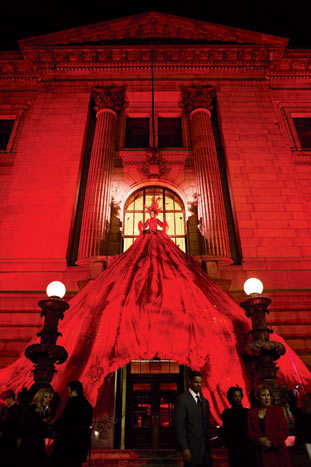
The American Heart Association’s 2006 Rhapsody in Red event had a dramatic event entryway designed by Matthew David Events: a model wore a silk organza dress with a 30-foot-long skirt that draped over the New York Public Library’s entrance.


At the 2006 opening of Parasuco’s flagship store, six dancers surprised guests by emerging from within a 14-foot-tall skirt for a live performance.


For a 2006 Motorola event, KSE Productions suspended a metal platform from the ceiling as an unconventional lectern and used stretch-fabric video screens as a backdrop.


For a private dinner in 2006, JMVisuals created an unexpected overhead lighting trick: rows of frosted votives suspended from the ceiling on square Lucite tiles.

To celebrate the renovation of Lincoln Center’s Alice Tully Hall in 2007, Roy Braeger designed a vertical stage that tied into the event’s construction-themed decor and gave guests an unobstructed view of the musicians.
At the 2008 Robin Hood Foundation gala, XO laptops on each dinner table displayed menus, statistics about the organization’s work, and images of flowers, and then were donated to city schoolchildren after the event.
The cocktail napkins for the 2002 opening of Prada’s store in SoHo in New York were useful in two ways, with an itinerary and maps showing the locations for the night’s multiple parties.


In what Target called a “vertical fashion show,” acrobats danced, posed, and catapulted down runways on the side of 620 Fifth Avenue, one of the buildings that flanks the ice rink at Rockefeller Center, in 2005.

Event Ideas We Love!

Waiters didn’t have to remember what they were serving (and guests didn’t have to ask) when now-defunct Match Catering printed T-shirts w...


Best Events Blog © 2015 - Blogger Templates Designed by Templateism.com, Plugins By MyBloggerLab.com